
Spend less of the build laying cable.
Place receivers at your speaker positions instead of running audio across the audience area. Reduce the cable crossings that need routing and protection.
Wireless audio for outdoor events
Send one desk feed to speakers across your site. Keep them timed to the stage. Leave the long audio cable runs behind.
For sound crews, hire companies and event organisers.
A better way to cover an open site
The bar, the back of the field, the far side of the marquee. Put sound closer to the people who need it, rather than asking the main PA to do everything.
Place receivers at your speaker positions instead of running audio across the audience area. Reduce the cable crossings that need routing and protection.
Set a separate delay for each speaker so its sound arrives just after the stage sound in its zone. Avoid the disconnected feel of an early local speaker.
See reception and timing margin from the desk. Change level, identify a receiver or mute the whole system without a walk across the site.
Included software
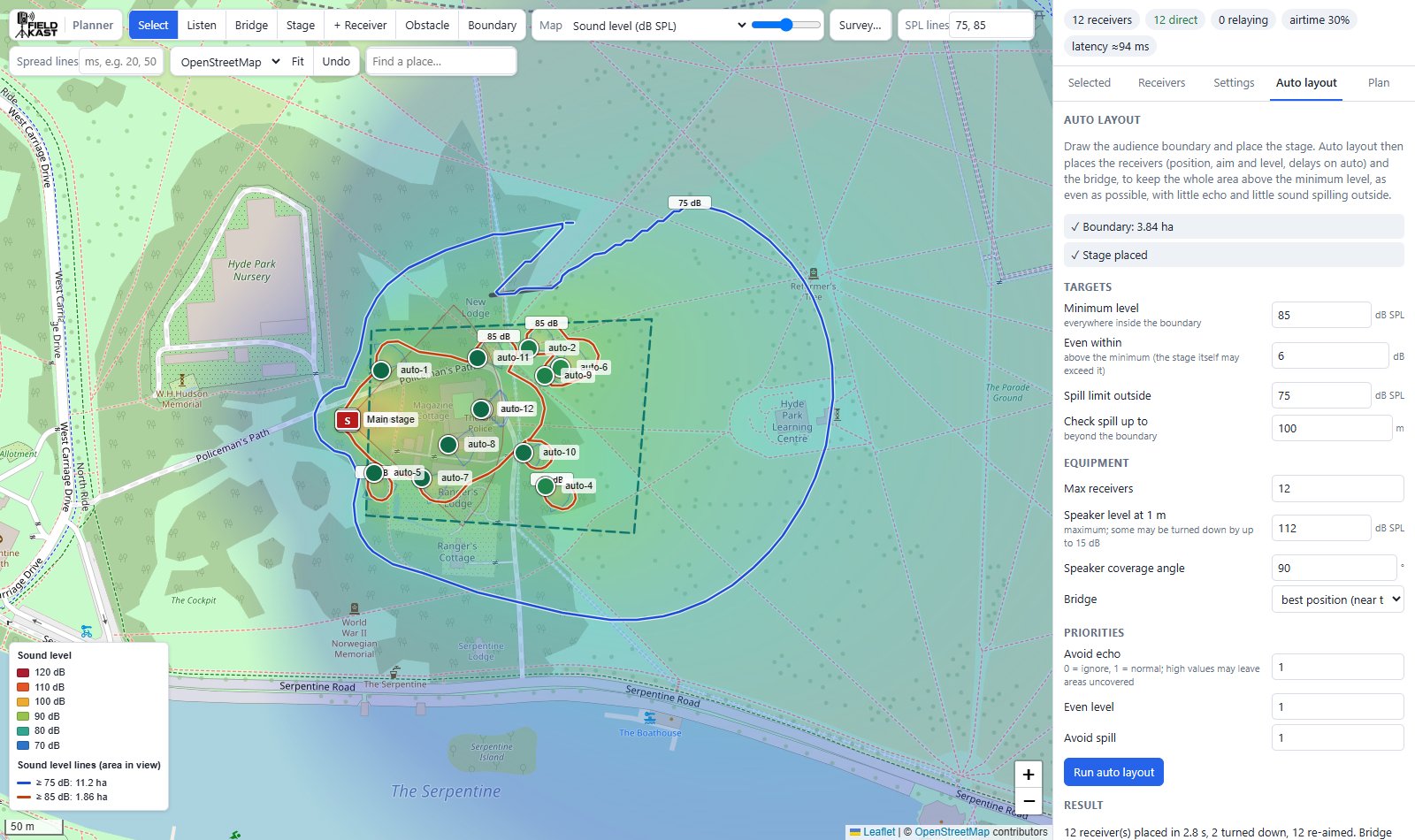
Decide where the speakers should go, guide the crew to the positions, then apply timing from where they actually ended up.
Explore the workflowCompare coverage, spill and echo risk on the map. Listen to a model of your own audio from different spots.
Phone guidance, QR identification and compass aiming connect the drawn layout to the real positions.
Apply receiver delays together. Watch reception and margin, adjust levels and mute remotely.
Own it
Reusable hardware for repeat events. Start with five positions, expand when your jobs do.
Kits from £675
View systems & pricesHire it
Build the enquiry around your site, speaker positions and dates. Size the system before you commit to equipment.
Quoted for your event
Plan your hireBefore you choose
FieldKast feeds a line-level input on an active speaker, or on an amplifier feeding a passive speaker. Check connectors and gain structure before the job. Speakers, tripods, speaker power and weather protection are separate from the radio kits.
It removes the long audio runs between front of house and the speaker positions. Each position still needs a short audio lead and power. The £20 receiver battery pack powers the receiver, not the loudspeaker. Battery-powered speakers are needed to remove the long mains runs as well.
It is intended for delay speakers further out, rather than band monitors. Default end-to-end latency is approximately 94 ms, including a 60 ms stream buffer. With a directly fed main PA, positions within roughly 30 m need a different approach. The planner checks the closest alignable distance for the actual settings.
The supplied documentation reports at least 250 m in line-of-sight open-grass tests. This is a field-test result, not a guarantee on a crowded site. Keep antennas above head height, coordinate 2.4 GHz use and walk-test the site. Receivers can relay through neighbouring units, up to four hops, subject to reception and timing margin.